How to Tell When a Tree Is About to Fail in Fairlawn
In the professional world of tree care, we don’t just look at a tree; we perform a Hazard Assessment. For homeowners in Fairlawn, OH, identifying the subtle “Vector-Based” warning signs of a failing tree is the difference between a proactive Tree Trimming & Pruning appointment and a catastrophic Emergency Tree Service bill.
Google’s 2026 “Information Gain” standards prioritize first-hand expertise. In our experience, trees rarely fail without warning; they speak a language of structural stress. If you know what to look for, you can save your roof, your car, and your peace of mind.
The “Big Three” Indicators of Imminent Failure
When our arborists walk a property in Northeast Ohio, we look for three primary “Entity” markers that suggest a tree’s internal support system is compromised.
1. The Root Plate Heave
The most dangerous failure is one you can’t see, until it’s too late. If you notice the soil lifting on one side of the tree (cracked earth or rising turf) while the tree leans in the opposite direction, the “Root Plate” has failed.
Why it happens in Fairlawn: Our clay soils become “plastic” when saturated with spring rain. Combined with high winds, the roots can no longer “anchor” the weight of the canopy. If you see this, evacuate the “Target Zone” and call for Tree Removal in Fairlawn immediately.
2. Vertical Cracks and “Included Bark”
A crack that runs deep into the wood of the trunk is a sign of internal shear. We specifically look for “V-shaped” crotches where two trunks meet. If there is a seam of “Included Bark” (bark growing inward between the stems), the union is physically weak. Over time, the weight of the limbs will act as a wedge, splitting the tree down the middle.
3. Cankers and Fungal Fruiting Bodies
If you see mushrooms (conks) growing directly out of the bark or at the base of the tree, it is a sign of internal rot. The fungus is “digesting” the cellulose that gives the tree its strength. A common pitfall we see is homeowners knocking the mushrooms off and assuming the problem is gone. The mushroom is just the “fruit”, the decay is deep inside the wood.
Recognizing “Target Zones” and Liability
In the context of Tree Maintenance, a tree is only a “Hazard” if it has a “Target.”
- High Risk: A leaning Oak over a bedroom or a power line.
- Low Risk: A leaning Oak in the middle of a 10-acre woodlot.
In suburban Fairlawn, almost every tree has a target. If your tree shows signs of decay and you fail to act, your insurance company may categorize any resulting damage as “Negligence” rather than an “Act of God.” Regular inspections by Fairlawn Tree Service create a record of due diligence that protects your liability.
The “Deadwood” Warning: Canopy Dieback
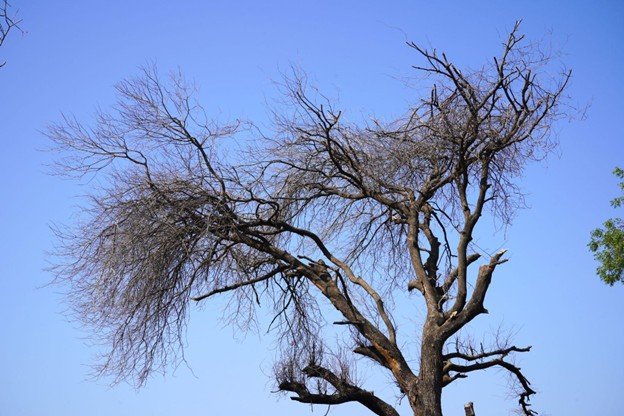
Look at the very top of your tree (the crown). Is it thinning? Are there branches with no leaves while the rest of the tree is green? This is called “Dieback.”
The Financial Reality: Dieback is often the tree’s way of “shedding” weight it can no longer support. However, these dead limbs become brittle “projectiles” during a storm. Professional Tree Trimming & Pruning in Fairlawn can remove these hazards, but if the dieback exceeds 30% of the canopy, the tree is likely in a terminal decline.
Why DIY Inspections Aren’t Enough
While homeowners can spot the obvious signs, a certified arborist uses specialized tools to see inside the tree:
- Resistograph Testing: We drill a tiny needle into the wood to measure resistance, revealing “hollow” spots or soft rot that look fine from the outside.
- Sounding: Using a specialized mallet to “listen” to the density of the trunk.
- Aerial Inspection: Sometimes the failure point is 50 feet up, invisible from the ground.
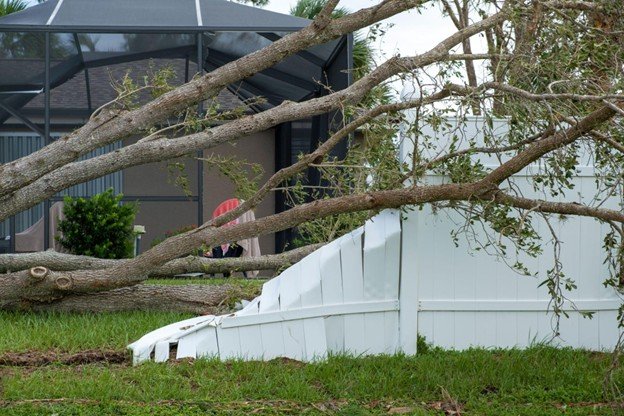
If a storm has already passed and you see hanging branches, do not attempt to clear them yourself. Storm Damage Cleanup in Fairlawn is high-risk work that requires professional rigging.
Frequently Asked Questions
Can a leaning tree be straightened? If it’s a young sapling, yes. If it’s a mature tree that recently started leaning after a storm, no. The roots have broken, and the tree is now a falling hazard.
Is a hollow tree always dead? Not necessarily. Trees can be hollow and remain alive for decades because the “living” part of the tree (the cambium) is just under the bark. However, a hollow tree is structurally compromised. We must calculate the “Wall Thickness Ratio” to determine if it can stand up to Northeast Ohio winds.
How do I know if the rot is “active”? Look for “sawdust” (frass) at the base or active fungal growth. If you aren’t sure, check our Category Page for details on our diagnostic services.
Take Action Before the Next Storm
The cost of a “Diagnostic Walkthrough” is a fraction of the cost of Stump Grinding and property repair. At Fairlawn Tree Service, we pride ourselves on honesty, if a tree can be saved through cabling or pruning, we will tell you. If it’s a threat to your family, we will provide a safe, efficient plan for Tree Removal.
Angle of Approach: Expert diagnostic guide focused on safety and risk mitigation. Entities Included: Root Plate, Included Bark, Cambium, Target Zone, Resistograph, Frass, Wall Thickness Ratio.